by Design Concepts Global
Share
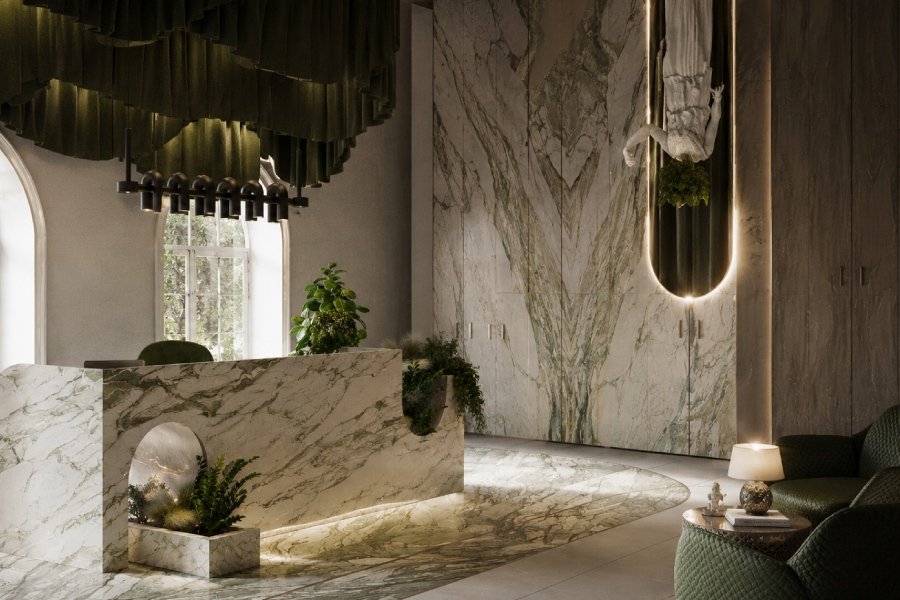
A bookmatched feature wall in a luxury hotel lobby, fine-dining restaurant, or flagship retail store often runs into six figures before the install team picks up a tool, and the slab itself is rarely what fails. The layout decision is. Choosing between a bookmatch marble wall and a random vein layout decides whether the wall reads as a brand statement or as expensive cladding. This guide breaks down both layouts, shows how interior designers plan them with fewer visible seams, and explains what the stone mockup approval process should deliver before a single slab is cut.
Bookmatch vs Random Vein in 60 Seconds
Bookmatch layouts mirror two adjacent slabs so the veins form a symmetrical pattern, like an open book. Random vein layouts place slabs without aligning the veins, letting the natural pattern fall as it does.
Choose bookmatch for symmetrical statement walls in lobbies, fine-dining interiors, and retail focal points. For restaurant interior design in Dubai, bookmatch usually works best at entrances, reception counters, bar surrounds, and private dining rooms where the wall becomes the first visual moment. Choose a random vein for large continuous walls where a natural, unforced look serves the brief better.
What Is a Bookmatch Marble Wall?
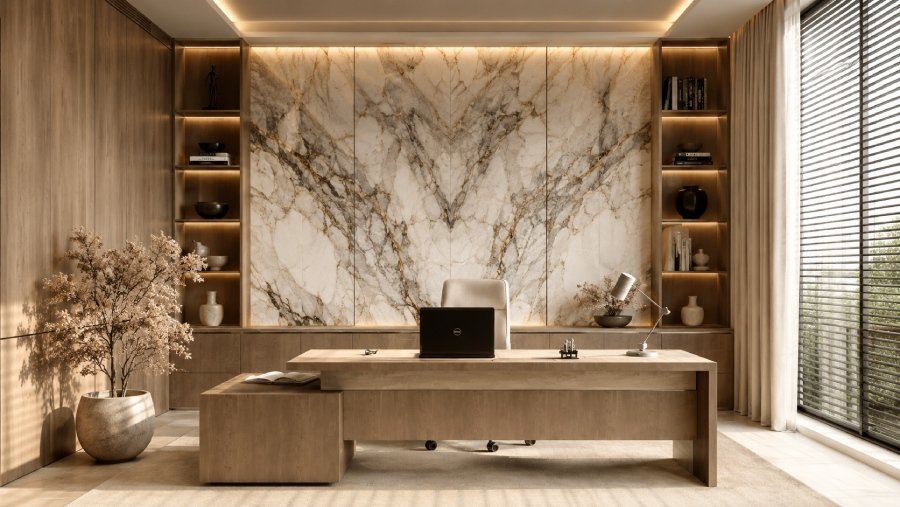
A bookmatch marble wall is a feature wall built from two or more slabs cut from the same block and arranged so their veining mirrors across the seam, like the open pages of a book. Fabricators slice adjacent slabs, then polish the opposing faces so the patterns reflect each other when installed.
The technique dates back to Byzantine architecture; the marble panels inside Hagia Sophia’s marble wall interiors are among the earliest surviving examples. Modern variations include quad-match and diamond-match, which extend the symmetry across larger walls.
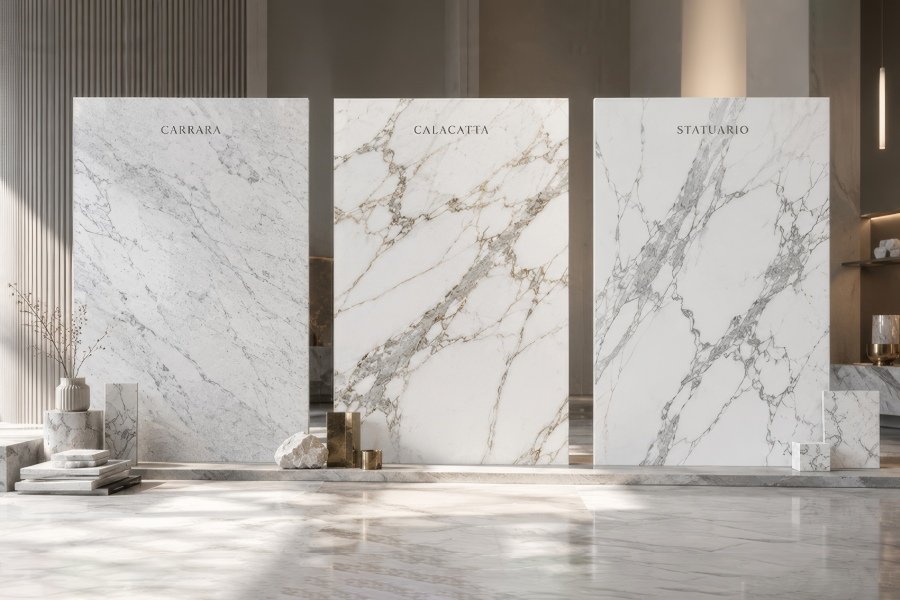
High-contrast marbles produce the most dramatic results; Calacatta, Statuario, Arabescato, and Patagonia Viola are top choices.
What Is a Random Vein Layout?
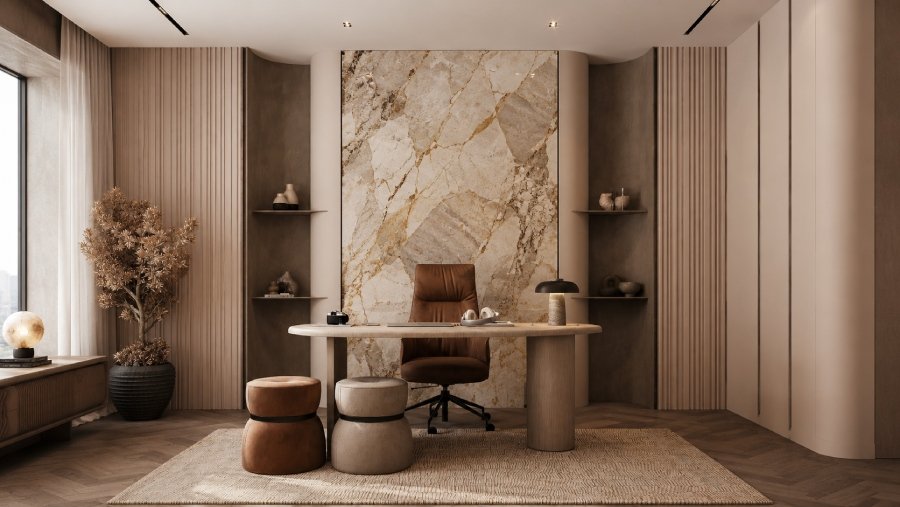
A random vein layout places each slab without aligning the veining to its neighbours, so the natural pattern reads as it falls rather than as a composed reflection. Fabricators select slabs for visual compatibility: tone, density, movement, but do not mirror vein lines across seams.
Also called free-lay or shuffle pattern, the technique is the practical standard for large continuous walls, curved surfaces, and stones too busy to mirror cleanly. It suits travertine, dense onyx, busy granites, and large-format porcelain.
The layout cuts slab waste, shortens lead time, and makes panel replacements easier years after installation.
Why Visible Seams Make or Break the Wall?
A seam becomes visible on a feature wall when six variables go wrong: slab edge condition, joint width, adhesive colour, vein misalignment, substrate flatness, and the angle of light hitting the wall. Get one of these wrong, and the seam reads first, the stone reads second.
The fix is layout-led. Bookmatching hides seams by turning them into symmetry axes; the eye reads the mirror, not the gap. Random vein layouts hide seams by visual distraction. There is no expected pattern, so the seam blends into the natural noise of the stone.
Raking light, where the source sits close to the wall surface, is the unforgiving test. The lighting plan should be approved before the slab layout, not after.
Choosing between bookmatch and random vein comes down to seven trade-offs — how the wall reads, what it costs, and how long it takes to deliver. The table below maps each variable side by side.
| Variable | Bookmatch Marble Wall | Random Vein Layout |
|---|---|---|
| Visual effect | Symmetrical, composed, formal | Natural, flowing, unforced |
| Best stones | High-contrast veined marbles: Calacatta, Statuario, Arabescato, Patagonia Viola | Busy or chaotic stones: travertine, dense onyx, large-format porcelain |
| Seam visibility | Hidden by symmetry, the eye reads the mirror | Hidden by distraction; the seam blends into the natural pattern |
| Cost premium | 30–60% above standard slab cost | Standard slab cost |
| Slab waste | High; multiple slabs needed for matched pairs | Low; most slabs are usable |
| Lead time | Longer; depends on block availability and matched cutting | Shorter; slabs ready off the rack |
| Project fit | Hospitality lobbies, retail flagships, fine-dining feature walls | Large continuous walls, curved surfaces, and large-format commercial areas |
Neither layout is universally better. Bookmatch wins where symmetry is the point. Random vein wins where scale, schedule, or stone character make symmetry the wrong tool.
When Bookmatch Wins and When Random Does?
Choose Bookmatch When the Wall Is the Focal Point
Bookmatch works best when the wall is the room’s primary visual moment, a hotel lobby reception, a restaurant entrance feature, a retail brand-signature wall, or a bar surround. The architecture should support symmetry, with the wall centred in the sight line from the entry.
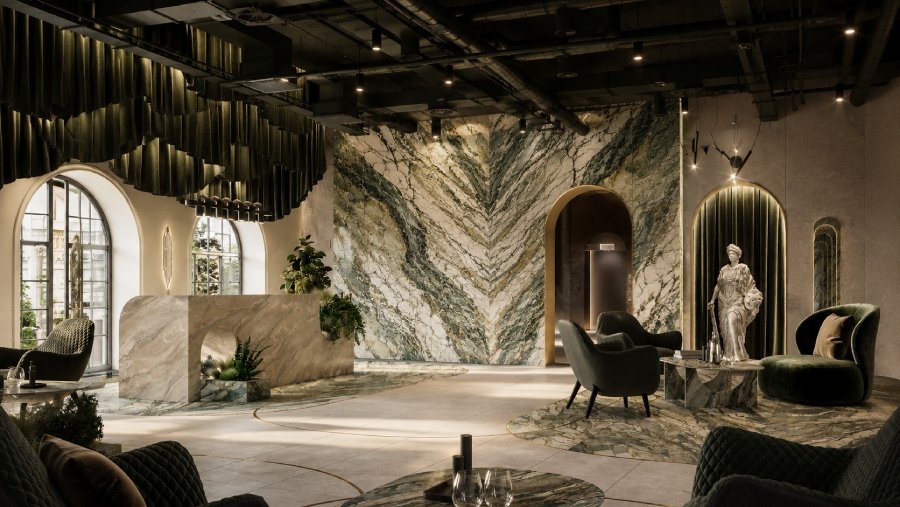
Choose bookmatch when the slab has bold, high-contrast veining, when the budget can carry a 30 to 60 per cent premium, and when the wall surface is at least 1.8 metres wide. Anything smaller and the symmetry doesn’t register.
Choose Random Vein When Scale or Stone Character Wins Over Symmetry
Random vein is the right call for large continuous walls, hotel corridor cladding, mall atriums, airport retail concourses, F&B chain locations where 20+ metres of stone needs to read as one surface. It also suits curved walls, where bookmatching breaks visually at every bend.
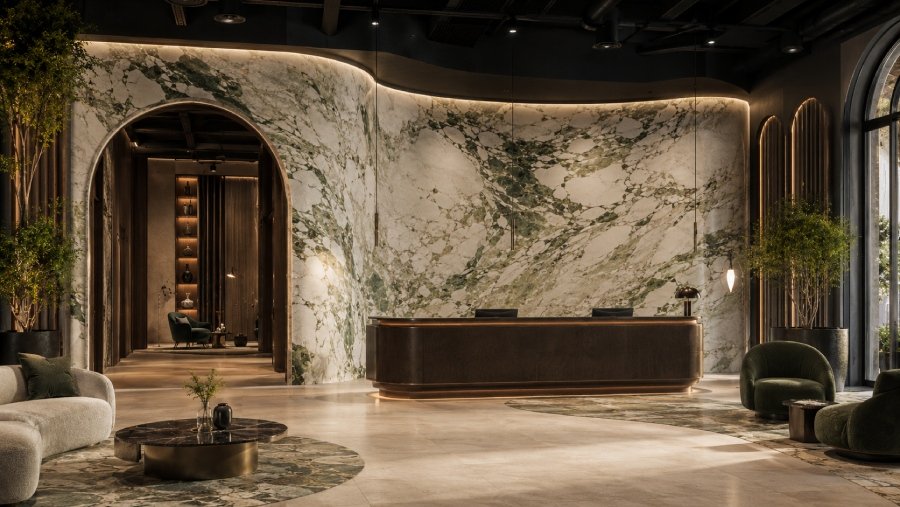
Choose a random vein when the stone’s natural figure is too busy to mirror, when the project schedule cannot absorb extended fabrication lead time, or when the layout calls for natural rather than composed energy. The technique also makes spare panels and future repairs straightforward.
How Interior Designers Approach Slab Layout Differently
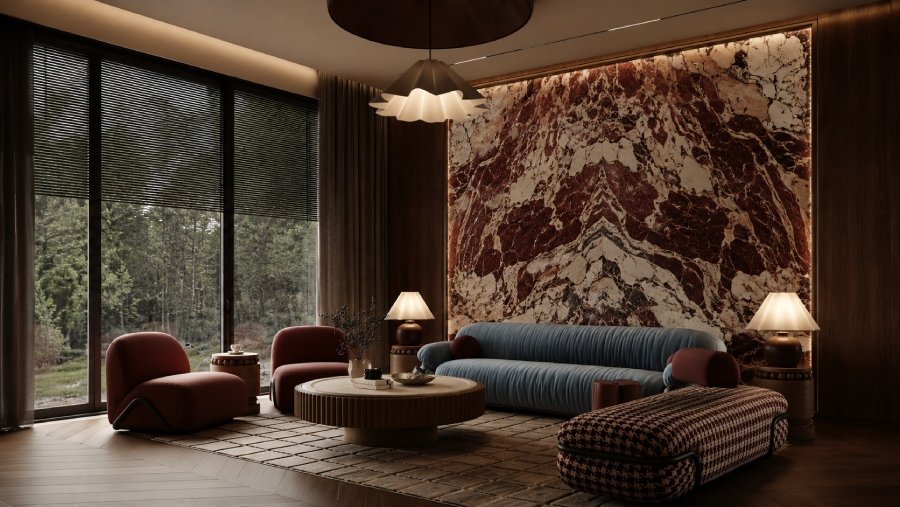
A fabricator optimises a slab layout for slab yield and clean joints. An interior designer optimises it for how the wall reads in context alongside joinery tone, ceiling height, lighting plan, sight lines from the entry, and the rest of the scheme. Both views matter. Only one of them protects the design intent.
A bookmatched feature wall behind a sculptural chandelier in a five-star hotel lobby reads as one composition. The same wall placed behind a long banquette in a fine-dining restaurant becomes a backdrop, not a focal point. The stone hasn’t changed the wall’s role in the room has.
A designer answers a different question than a fabricator. Not can it be cut, but should this room carry it. Vein direction is one variable. Where the eye lands when a guest walks in is the brief.
Slab Layout Design: The Four-Stage Workflow
Slab layout design is the four-stage process of translating a chosen stone into an installed feature wall: slab yard visit, CAD elevation, dry-lay simulation, and joint specification. Each stage closes a risk before fabrication begins.
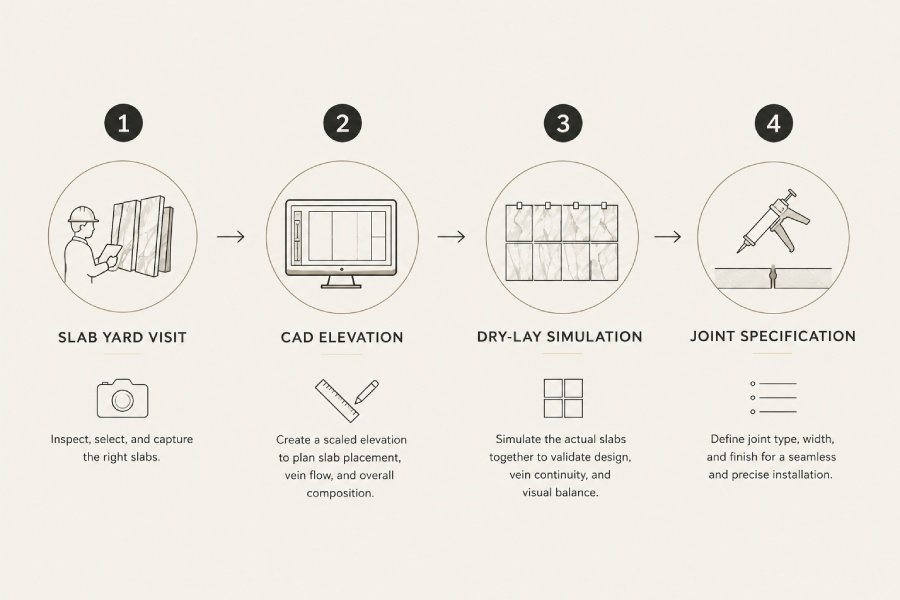
1. Slab yard visit with the client.
Photograph full slabs in daylight, mark vein direction, confirm consecutive numbering, and verify the block was cut for bookmatching. Not every block is.
2. CAD elevation with vein mapping.
Position slab joints at architectural breaks, door heads, ceiling lines, niche edges, and keep them off eye level. Substrate flatness should hold to ±3mm over 3 metres, the Natural Stone Institute’s published tolerance for slab installations. Use industry terminology consistently when specifying dimension stone; ASTM C119 is a recognised reference for dimension stone terminology.
3. Dry-lay simulation.
Confirm the layout in a full-scale physical mockup or a digital overlay of photographed slabs on the actual elevation.
4. Joint and adhesive specification.
Lock joint width, adhesive colour match, and polish direction before any stone is cut.
Stone Mockup Approval: The Most Important Hour of the Project

Stone mockup approval is the formal sign-off stage where a designer presents the planned slab layout to the client, either as a full-scale physical dry-lay at the fabricator’s yard or as a high-fidelity digital rendering of photographed slabs on the actual wall elevation. It is the last point at which the layout can be changed without scrap cost.
The approval covers four things: vein alignment across seams, joint placement against architectural breaks, colour tone under the project lighting plan, and edge profiles. Once signed off in writing, the drawing is released to the fabricator. This is why a design and build approach can reduce late-stage risk: the design intent, procurement, fabrication, and site supervision are managed as one connected process
The sequence matters. The designer presents the mockup, signs it off with the client, and only then releases it to the fabricator. That is what a stone yard working directly for a client cannot deliver.
Cost, Lead Time, and Slab Waste — The Real Numbers
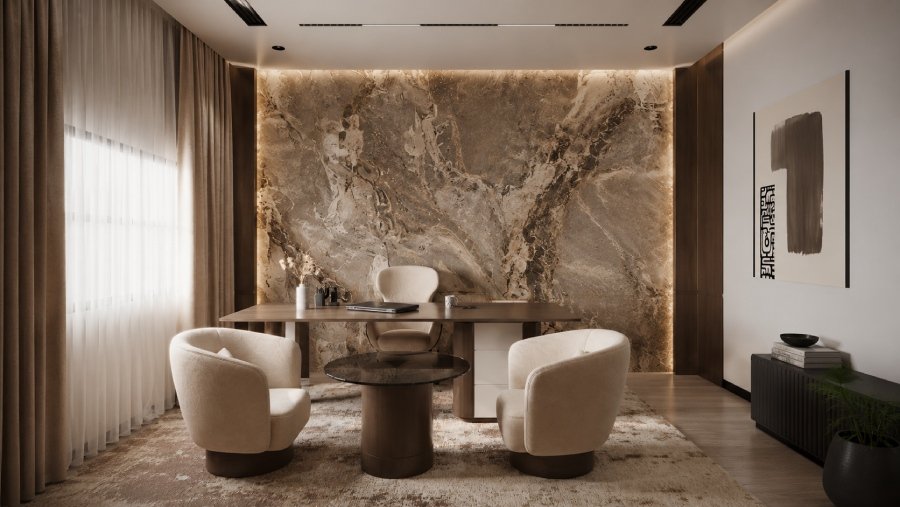
Bookmatching adds roughly 30 to 60 per cent to slab cost compared to a random vein layout. The premium comes from three factors: more slabs needed to find matched pairs, additional back-face polishing on bookmatched halves, and edge-trimming waste from matching adjacent slab edges.
Lead time is the other hidden cost. Bookmatched orders depend on block availability and matched cutting at the quarry, often adding two to four weeks to fabrication. Random vein orders ship from existing slab stock.
On a full-service design engagement, the bookmatch premium becomes a smaller share of overall project value. Before confirming the final surface treatment, compare the stone’s layout with the finish itself. Our guide on stone finishes in Dubai interiors explains how polished, honed, leathered, and flamed finishes behave across lobbies, restaurants, bathrooms, kitchens, and outdoor spaces. Since the firm is already coordinating procurement, fabrication, and installation as part of the wider scope, the finish decision can be aligned properly with the overall design and execution plan.
Questions to Ask Your Interior Designer Before Approving the Layout
Before signing off on the slab layout, commercial clients should put five direct questions to their design team. Each answer reveals whether the project is being run by a serious process or improvised at install.
- Have you mocked up the wall at full scale before sign-off?
- Where are the joints landing, and have you kept them off eye level?
- Will the design team walk the slab yard with us, or are we approving from photos?
- What does the install supervision schedule look like?
- Who inspects and signs off when the slabs arrive on site?
The real decision isn’t bookmatch versus random vein. It’s the layout that serves the architecture, the stone, and the brief. Both are right answers, for different projects.
At Design Concepts, a bookmatched feature wall is one chapter in a wider interior story. Our interior design company handles layout, slab sourcing, mockup approval, and installation supervision for hospitality, F&B, retail, and corporate projects across the UAE. Start with a consultation.